Soil Creep: Diagram, Causes and Evidence
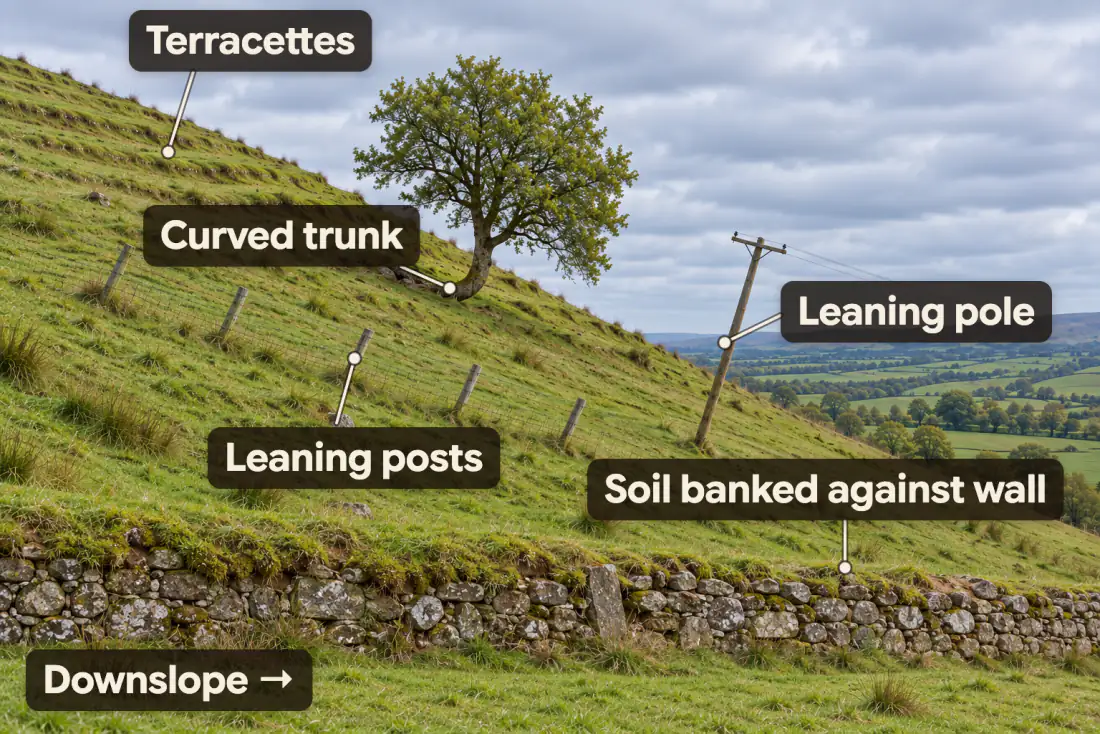
Soil creep is the slowest form of mass movement: soil sliding downhill under gravity at roughly 1 to 3mm a year in a temperate climate like Ireland's. It is too slow to watch, so it is identified by what it leaves behind, including terracettes, curved tree trunks and leaning fence posts.
Last reviewed 19 August 2026
What soil creep looks like on a slope
Why it happens: the zigzag path of one soil particle
Why soil moves when nothing appears to happen
Gravity pulls on every particle of soil on every slope, all the time. What stops the whole hillside sliding is friction and the binding effect of roots. Creep is what happens in the narrow margin where gravity wins slightly, over and over, for years.
The mechanism is repeated swelling and shrinking. When soil freezes, the water in it expands and pushes particles outward, at right angles to the slope surface. When it thaws, the support goes and the particle falls vertically, because gravity pulls straight down rather than back along the line it came up. The particle ends its cycle very slightly further downhill than it started. Wetting and drying does the same thing through a different route: wet soil swells, dry soil contracts.
Repeat that a few thousand times and the whole surface layer has migrated.
The evidence you can actually see
Because creep is too slow to observe directly, it is identified through the things it deforms. Anything rooted or planted in creeping soil gets its base dragged downhill while its top stays put.
- Curved tree trunks. The base of the trunk is pushed downslope, the tree responds by growing vertically again, and the result is a permanent bend near ground level.
- Leaning fence posts, telegraph poles and gravestones. All tilt downslope over years.
- Soil banked against walls. Material piles up on the uphill side of a wall while the downhill side stays clear.
- Terracettes. Small parallel steps running across the slope. They are often mistaken for sheep paths, and livestock genuinely do use and widen them, but the steps originate in the soil movement itself.
- Broken or bulging retaining walls, where the pressure of accumulating soil eventually exceeds what the structure can hold.
Where creep matters in Ireland
Creep is not dramatic, which is why it is easy to ignore, but it is relentless and it is everywhere there is a slope. On farmland it slowly moves topsoil off the upper parts of a field and deposits it at the bottom, so the soil at the top of a sloping field is often thinner and less fertile than the soil at the base. That gradient shows up in soil test results taken from different parts of the same field, which is one practical reason sampling advice always says to walk a W pattern across the whole area rather than taking one convenient sample.
For anyone building on a slope, creep is a design consideration rather than a hazard. It will not destroy a structure suddenly, but over decades it puts steady lateral pressure on retaining walls, fence lines and boundaries.
Creep in the family of mass movements
Mass movement is classified by speed and by how much water is involved. Creep sits at the slow, dry end:
| Process | Typical speed | Character |
|---|---|---|
| Soil creep | 1 to 3mm per year | Continuous, affects entire slopes |
| Solifluction | Centimetres per year | Waterlogged soil over frozen ground |
| Slumping | Metres per hour or faster | Rotational failure, often at a coastline |
| Landslide | Metres per second | Sudden failure of a defined mass |
The distinction that matters for exams and for fieldwork is that creep is a continuous process affecting whole slopes, while landslides and slumps are discrete events affecting a defined mass of material.
Frequently asked questions
What is soil creep?
Soil creep is the very slow downhill movement of soil under gravity. It is the slowest category of mass movement, typically shifting soil a few millimetres a year, and it affects almost every slope rather than a few unstable ones.
How fast is soil creep?
In temperate climates it usually moves soil about 1 to 3mm per year. Rates are faster in warm, wet conditions, reaching around 10mm a year in tropical forest soils.
What causes soil creep?
Repeated expansion and contraction of the soil, driven by freeze and thaw or wetting and drying. Each time the soil swells it lifts particles at right angles to the slope, and each time it shrinks gravity pulls them straight down. The result is a net movement downhill.
What are terracettes?
Terracettes are the small step-like ridges that form across a grassy slope where soil is creeping downhill. They often look like narrow sheep paths, and grazing animals do widen them, but the steps themselves are produced by the soil movement.
What is the evidence for soil creep?
Curved tree trunks, leaning fence posts and telegraph poles, tilted gravestones and walls, soil banked up against the uphill side of a wall, and terracettes on the slope surface.
How is soil creep different from a landslide?
Speed and scale. Creep is continuous, affects the whole slope, and moves millimetres a year. A landslide is a sudden failure of a defined mass of material and can move metres in seconds.
Sources
- Soil Creep, overview , ScienceDirect Topics
- Soil Creep , Penn State University, GEOSC 10 Geology of the National Parks
Related
Want to know what your own soil is doing?
A soil map tells you what you have inherited. A soil test tells you what you can change. Compare what Irish labs charge before you order one.
Compare soil testing prices