Soil Profile and Horizons: Labelled Diagram
A soil profile is a vertical slice through soil from the surface down to bedrock. The distinct layers you can see in that slice are called horizons, and they always appear in the same order: O, A, E, B, C, then R.
Last reviewed 19 August 2026
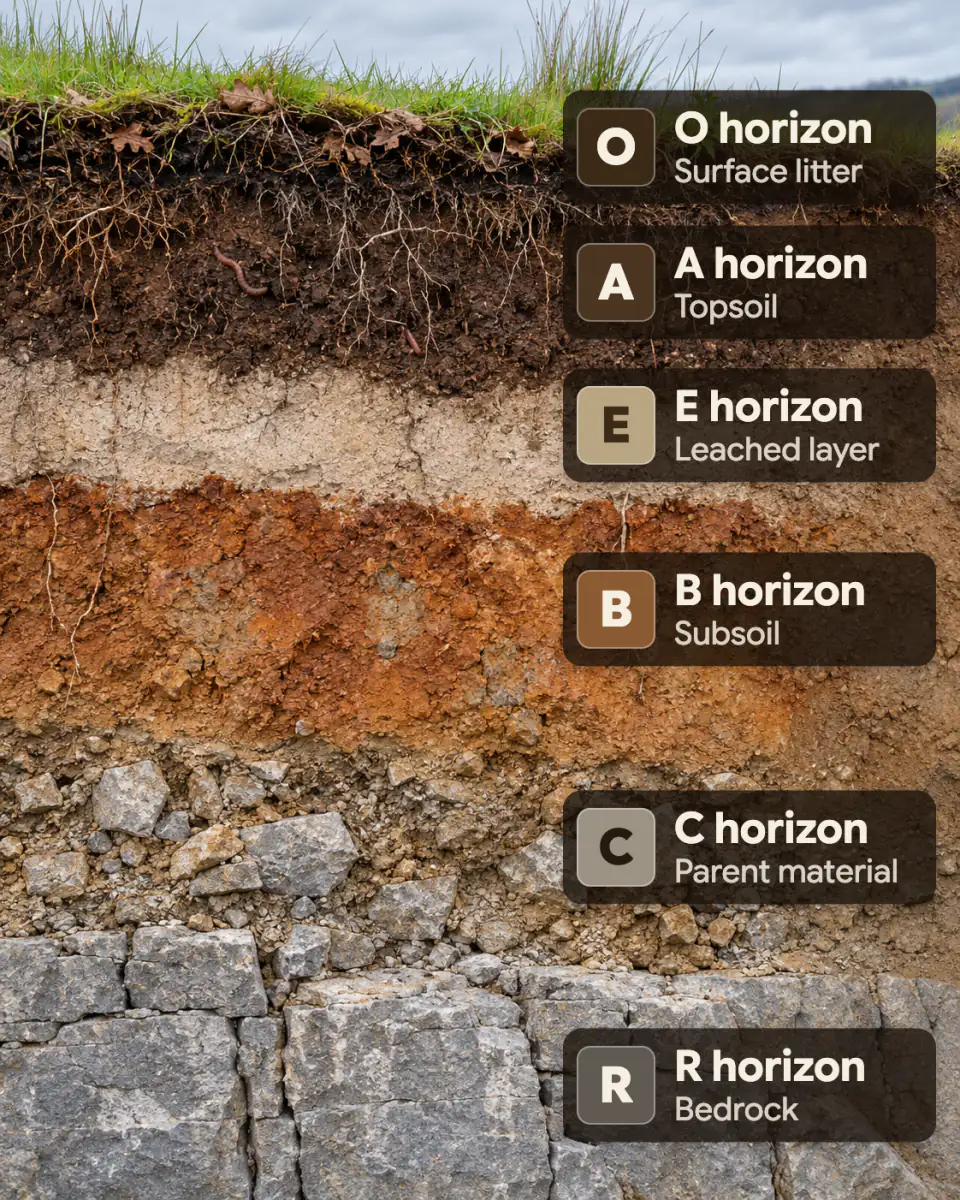
The layers, from the top down
Dig a hole deep enough and the soil stops looking like one thing. Colour changes, texture changes, and the boundaries between the bands are often sharp enough to trace with a finger. Those bands are horizons, and each one is the result of a different process.
O horizon: surface litter
The organic layer sitting on top of the mineral soil. Leaves, dead grass, roots and partly rotted plant material. In a garden bed it might be a centimetre of mulch. Under Irish blanket bog it can be metres deep, because waterlogging stops the material breaking down.
A horizon: topsoil
Dark, crumbly, and the layer everything depends on. It is mineral soil mixed with humus, and it holds the great majority of roots, earthworms and microbial life. This is what a soil test samples, what a plough turns, and what erosion takes first.
E horizon: the leached layer
Pale and often sandy, because water moving downward has stripped the clay, iron and aluminium out of it. The letter stands for eluviation, which simply means washing out. You will see a clear E horizon in a podzol and rarely anywhere else.
B horizon: subsoil
Where the material lost from above ends up. Clay, iron and aluminium accumulate here, which is why the B horizon is usually denser, heavier and more strongly coloured than the layers over it. A reddish or orange B horizon is iron. A grey or blue-grey mottled one is a sign of waterlogging.
C horizon: parent material
Broken, weathered rock, or the glacial till that covers most of Ireland. This is the raw material the soil above has been made from, and it explains a great deal about the soil’s character. Soil over limestone behaves differently from soil over granite.
R horizon: bedrock
Solid, unweathered rock. Roots stop here.
Why Irish profiles rarely look like the textbook
The textbook profile with six tidy bands is a teaching model, not a description of any particular field. Ireland’s soils depart from it constantly, for three reasons.
Glaciation reset the clock. Most Irish soils have formed on glacial till laid down within the last 20,000 years, which is not long in soil terms. Profiles are young and often shallow.
Rain moves material downward. Persistent rainfall drives leaching, which is why podzols with their bleached E horizon occur across Irish uplands and why acidity is a recurring problem.
Drainage decides everything. Gleys, the single most common soil type in Ireland at 24.5% of land area according to the EPA’s 2024 State of the Environment report, form where water sits. In a gley the B horizon turns grey, blue-grey or mottled rather than brown, because iron in waterlogged soil changes chemical state. Grey subsoil is a reliable field sign that you are standing on ground that does not drain.
How to see a profile for yourself
You do not need a soil pit. Any fresh road cutting, drainage ditch, riverbank or newly dug foundation gives you a free cross-section. Look for the change in colour first, since that is usually the clearest boundary, then feel the texture of each band between your fingers. Topsoil crumbles. Subsoil with clay in it will smear and hold a shape.
If what you find is grey and sticky within a spade’s depth, that is a gley, and it will tell you more about what will grow there than any amount of feeding.
Frequently asked questions
What is a soil profile?
A soil profile is a vertical cross-section through soil, from the surface down to the parent rock. It shows the layers, called horizons, that have formed as water, roots, weather and soil life have worked on the material over time.
What are the six soil horizons in order?
From the top down: O (surface litter), A (topsoil), E (leached layer), B (subsoil), C (weathered parent material) and R (bedrock). Not every profile shows all six.
What is the difference between the A horizon and the B horizon?
The A horizon is dark topsoil where organic matter, roots and soil life are concentrated. The B horizon below it is the subsoil, where clay, iron and aluminium washed down from above accumulate. Material leaves the A horizon and arrives in the B horizon.
Which horizon is the topsoil?
The A horizon is the topsoil. It is the layer gardeners dig and farmers plough, and it holds most of the roots, earthworms and organic matter.
Why can I not see an E horizon in my garden?
The E horizon only forms where water moves down through the soil strongly enough to strip out clay and iron. It is obvious in podzols, which cover about 7% of Ireland, and largely absent from the brown earths and gleys that most Irish gardens sit on.
How deep is a soil profile?
It varies enormously. A thin rendzina over limestone can reach bedrock within about 30cm, while blanket peat in the west of Ireland can be several metres of organic material before any mineral soil appears.
Sources
- Soil Classification , Teagasc
- Irish Soil Information System: Interactive Soil Map , Teagasc
- Ireland's State of the Environment Report 2024, Chapter 6: Soil , Environmental Protection Agency
Related
Want to know what your own soil is doing?
A soil map tells you what you have inherited. A soil test tells you what you can change. Compare what Irish labs charge before you order one.
Compare soil testing prices